Friday, July 29, 2011

Thursday, July 21, 2011
6 Reasons to Smile Right Now

People with big grins live longer. In a study published last year, researchers pored over an old issue of the Baseball Register, analyzing photos of 230 players. They found that on average, the guys with bright, bigmouthed beams lived 4.9 years longer than the players with partial smiles, and 7 years longer than the players who showed no grin at all. We can't credit wide smiles for long life spans, of course, but smiles reveal positive feelings, and positive feelings are linked to well-being.
Smiles exert subliminal powers. When study subjects are shown an image of a smiling face for just four milliseconds—a flash so quick, the viewers don't consciously register the image—they experience a mini emotional high. Compared with control groups, the smile-viewers perceive the world in a better light: To them, boring material is more interesting, neutral images look more positive, even bland drinks seem tastier.
There are three degrees of happiness... An article in the British Medical Journal reported that it is indeed possible to spread the love: Within social networks, when one person is happy, the feeling migrates to two people beyond her. So if you smile, a friend of a friend is more likely to smile, too.
...and two types of smiles. Genuine smiles and fake smiles are governed by two separate neural pathways. We know this is true because people with damage to a certain part of the brain can still break into a spontaneous grin even though they're unable to smile at will. Scientists speculate that our ancestors evolved the neural circuitry to force smiles because it was evolutionarily advantageous to mask their fear and fury.
To spot a faker, check the eyes. When someone smiles out of genuine delight, a facial muscle called the orbicularis oculi involuntarily contracts, crinkling the skin around the eyes. Most of us are incapable of deliberately moving this muscle, which means that when a person fakes a smile, her orbicularis oculi likely won't budge.
Smiles have accents. When reading facial expressions, different cultures home in on different parts of the face. In the United States, we focus on mouths; the Japanese, by contrast, search for feeling in the eyes.
Source: http://www.oprah.com/health/Smile-Research-and-Facts-Different-Types-of-Smiles?TW=tw_omag_smile_research#ixzz1SleBNuB5
I thought this was a great read - hope you all enjoy it :)
scent full of love,
Jordyn
Peak and Pit: July 21st
Peak: Passed my driving test... can finally say hello to that G2 :)
Pit: Can't stop biting my nails!
Pretty good, hot summer day so far in lil' old Sudbury! Can't wait to drive to camp tomorrow & get by the water. Nothing beats summer time, that's for sure.
scent full of love,
Jordyn xoxo
PS. Best summer song so far: "Honey Bee" by Blake Shelton. A relaxing and laid-back melody with some easy country lyrics -- love it!
Pit: Can't stop biting my nails!
Pretty good, hot summer day so far in lil' old Sudbury! Can't wait to drive to camp tomorrow & get by the water. Nothing beats summer time, that's for sure.
scent full of love,
Jordyn xoxo
PS. Best summer song so far: "Honey Bee" by Blake Shelton. A relaxing and laid-back melody with some easy country lyrics -- love it!
Monday, July 18, 2011
Skin Tips: Benefits of Agave Nectar
What is Agave Nectar?
Agave Nectar comes from the Agave plant, best recognized as the plant from which tequila is made. At first glimpse, the plant looks uninviting with its razor sharp leaves protruding from all angles. Nobody would even imagine the greatness that lies beneath that harsh exterior... the greatness that is agave's nectar.

The ancient Aztecs prized the agave as a gift from the gods and used the liquid from its core to flavor foods and drinks. Now, due to the increasing awareness of agave nectar's many beneficial properties, it is becoming the preferred sweetener of health conscious consumers, doctors, and natural foods cooks... as well as the preferred ingredient in many skin care products.
What are the Benefits of Agave Nectar?
Blue agave nectar was used by the Aztecs in Mexico for hundreds of years as a folk remedy to cure many types of skin conditions and wounds. Recent researchers also agree that Agave has abundant remedial potential. If applied on the skin surface, Agave nectar is found to provide relief from pus producing bacteria such as Staph aureus. When salt gets added to Agave nectar, its anti-microbial property gets even further boosted! Agave nectar is also known for its anti-aging properties.
What are the best Agave products to use right now?
We've scoured the beauty shelves and online stores throughout North America, and have found the two best Agave products: Agave Nectar Body Oil by FarmHouse Fresh Goods and the Agave Soy Candle by Archipelago Botanicals. Both infused with Agave plant extracts, yet both with different and fascinating purposes.
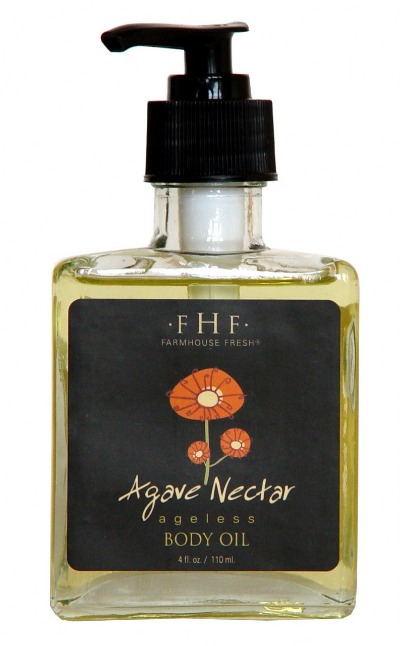
A powerful anti-aging/massage oil, rich with extracts. This light body oil is infused with Agave plant extracts, Sandalwood, Barley and Amurense Bark – a combination that has been proven to significantly improve skin’s trans epidermal water loss, resulting in a hydrated, plumper, less wrinkled appearance. The mild milk and oat scent is so mild, yet sweet and scrumptious.
What we love the most is that this product contains NO Parabens, SLS, or Mineral Oil that would otherwise conflict with the extremely beneficial properties of the agave nectar.

This hand-poured Agave soy candle contains more than 70% natural soy wax which burns longer and cleaner than regular candles. Approximate burn time- 90 hours! Another important point to note is the mixture of agave extracts with the natural soy ingredient, ensuring there is no conflict with the agave's soothing aromatherapy properties. We found this beautiful Agave product by recommendation of GQ magazine, a source we trust and love.
Take Inventory of Your Miracles

Have you become so consumed that your vision has become blurred or have you lost faith in your belief in miracles? If so, I urge you to take a moment to yourself, get quiet, and observe your present place in life. You may not be exactly where you desire to be physically, mentally, emotionally, or spiritually, but you are further along than when you first began. Even if your progress was made by short steps, progress was made.
If you still have difficulty believing in miracles, just look in the mirror and you will see one of the greatest miracles ever created...
- Loren Ridinger (lorensworld.com)
Subscribe to:
Posts (Atom)